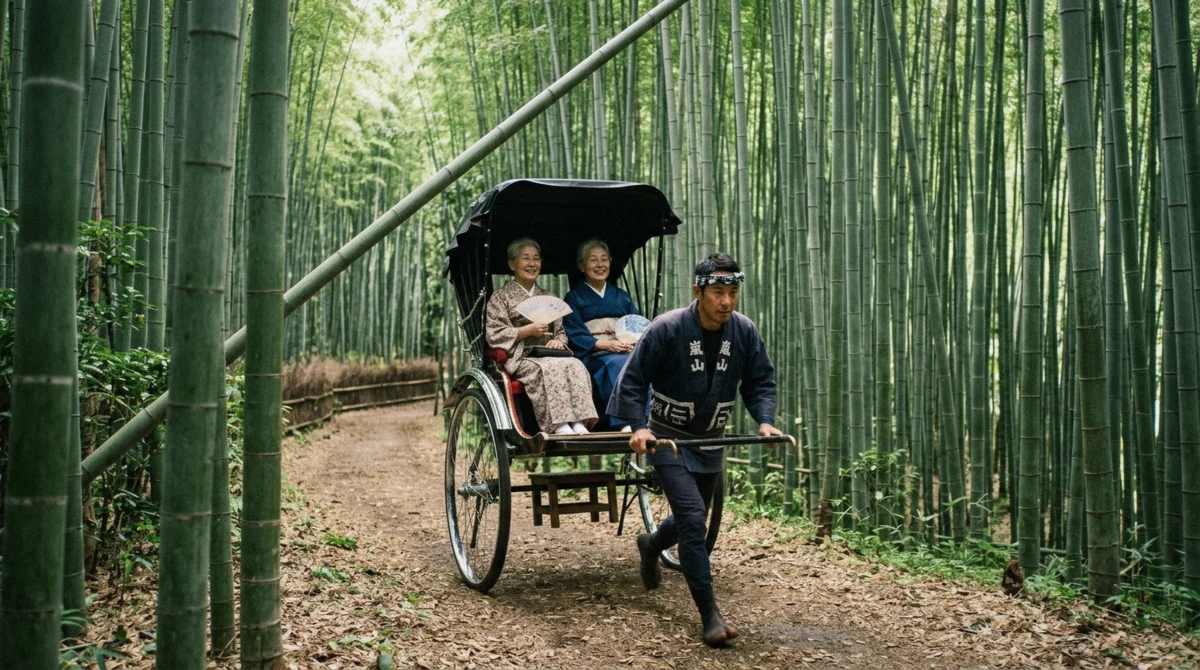
Sagano Bamboo Forest
Sagano Bamboo Forest History: What It Is and Why It's Here
The Sagano Bamboo Forest history question has two separate answers layered on top of each other: a natural one, why a single species of giant bamboo grows this densely in one district of Kyoto, and a cultural one, why an imperial shrine, a Zen temple founded in 1339 and a 20th century actor's villa all sit along the same 400 metre path. Both stories explain what a visitor is actually walking through, not just what it looks like.
Quick answer
The Sagano Bamboo Forest grew out of Moso bamboo cultivation in a district that has carried imperial and literary significance since the Heian era. Nonomiya Shrine, inside the grove, was where unmarried princesses purified themselves before serving at Ise Shrine and appears in the Tale of Genji; Tenryu-ji, founded in 1339 and a UNESCO World Heritage site since 1994, anchors the grove's south end. Entry to the path itself has been free since a fee was dropped around 2015.
Key takeaways
- Sagano and Arashiyama name the same grove: Sagano is the flat district, Arashiyama the mountain south of the river whose name spread over the whole quarter
- Nonomiya Shrine, free to enter, is the oldest layer of the site's history and appears in the Tale of Genji's "Sakaki" chapter
- Tenryu-ji was founded in 1339 and became a UNESCO World Heritage site in 1994; its garden costs ¥500
- The path has been free since 2015; before that a small entry fee applied
- Guides on the private walking tour tell these stories stop by stop rather than leaving you to read a sign
- Wondering if a visit is worth building a day around? See our honest is it worth it breakdown
Tours That Walk You Through the History
A guide who actually explains what you are passing turns the grove from a photo stop into something you understand. The private walking tour shapes its route around the shrine, the temple and the villa at your own pace, and the rickshaw tour's longer options pass Rakushisha, the haiku poet's cottage, on the way through back-lane Sagano.
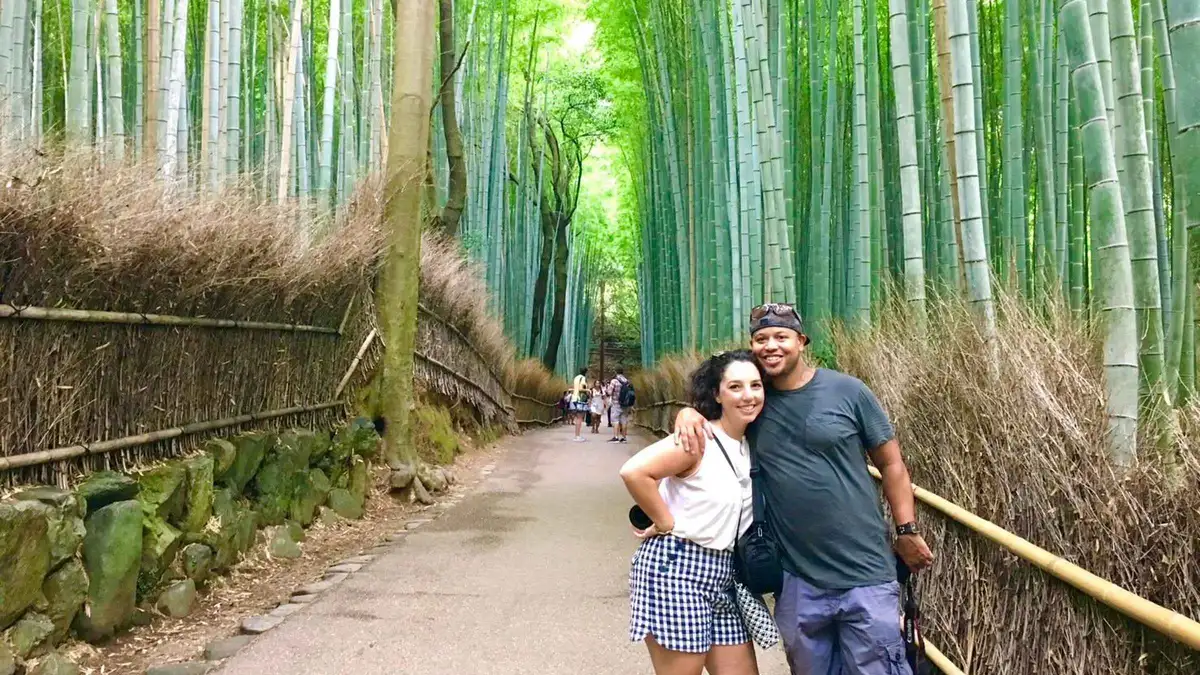
Kyoto Arashiyama Bamboo Forest Customized Private Tour
Four hours with a licensed English-speaking guide who shapes the route around you — bamboo grove, temples, riverside, whatever fits. Nothing else is bundled: transport, entries and lunch for you and your guide are paid on the day, which is how the price stays under most private tours.
- Cancellation
- Free cancellation 24h
- Operator
- Japan Wonder Travel
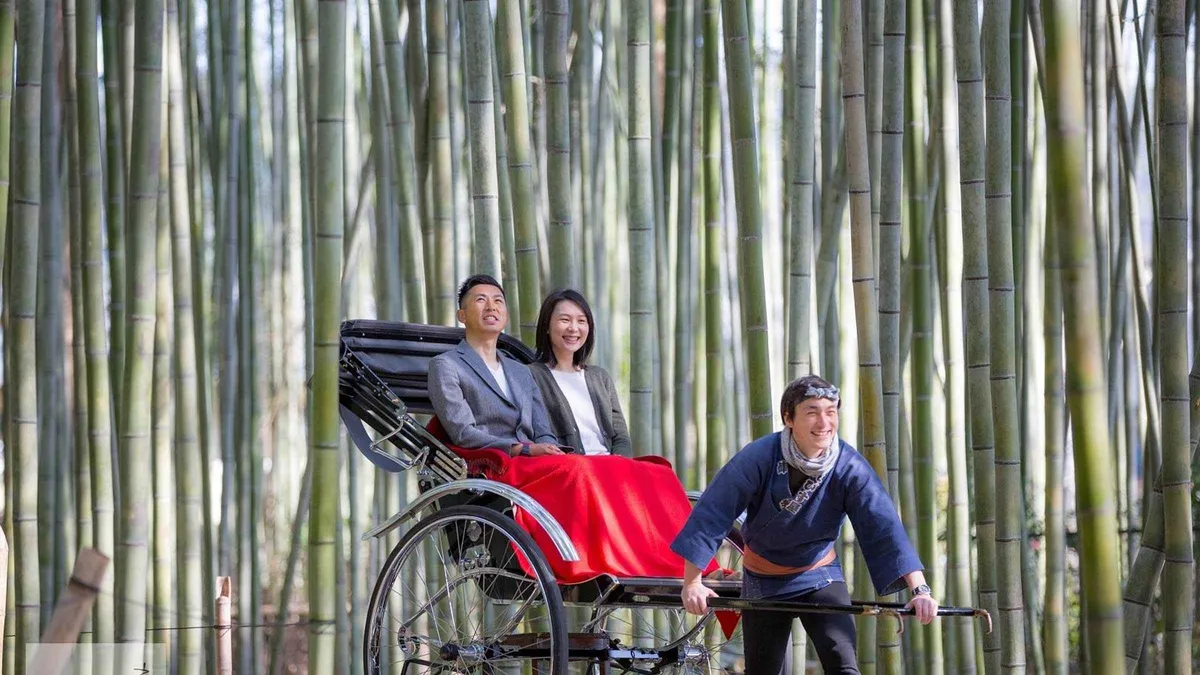
Kyoto: Arashiyama Customized Rickshaw Tour & Bamboo Forest
A private rickshaw with your own puller-guide, and the single biggest thing money can buy here: access to the fenced rickshaw-only lane through the bamboo, the stretch walkers never enter. Four lengths from 45 minutes to just over 3 hours; longer options add Rakushisha cottage and Nison-in.
- Cancellation
- Free cancellation 24h
- Operator
- Ebisuya Rickshaw
What the Grove Actually Is
A managed grove, not a wild forest
The Sagano Bamboo Forest is not untouched wilderness. It is a long-cultivated stand of Moso bamboo running along a signed path called Chikurin-no-Komichi, the small path of the bamboo grove, connecting Nonomiya Shrine at its southern end to the gate of Okochi-Sanso villa at its northern end. Local families and temple grounds have tended bamboo groves in this area for centuries, both for building material and for the ornamental value the stalks carry in Japanese garden tradition.
What makes it read as a single grove rather than a scattering of private plots is the path itself: a narrow, gently uphill walk of about 400 metres, roughly 10 to 15 minutes at a relaxed pace, with the stalks close enough on both sides to blot out most of the sky.
Two names for one place
Sagano is the flat district lying north of the Katsura River. Arashiyama is technically the mountain rising south of the river, but the name spread outward over time to cover the whole surrounding quarter, temples, shopping street and grove included. Visitors searching for either name end up at the same 400 metre path; this site uses "Sagano" because that is the more precise historical label for the district the grove actually sits in, while "Arashiyama" remains the name most people search first.
One grove, three names
| Name | Who uses it | What it means |
|---|---|---|
| Chikurin-no-Komichi | Japanese signage | The small path of the bamboo grove |
| Sagano Bamboo Forest | The scenic railway, rickshaw crews, this site's district name | Sagano, the flat district north of the Katsura River |
| Arashiyama Bamboo Grove | Most guidebooks and tour listings | Named for the mountain across the river whose name spread over the quarter |
Why Bamboo Grows Here
Moso bamboo, and how fast it moves
The species behind the grove is Moso bamboo, the largest bamboo commonly grown in Japan, capable of reaching roughly 20 metres in height. Its growth pattern is what makes the grove feel almost otherworldly if you happen to walk it during the spring growth spurt: a single shoot can add about a metre of height in a single day while it is pushing upward fastest, before the stalk hardens and stops growing entirely for the rest of its life.
That speed is also why a bamboo grove reads as dense so quickly compared with a forest of trees. A stand planted or thinned a few years ago can already stand at full height, which is part of why this particular grove has kept its scale generation after generation with relatively modest upkeep.
A sound worth listing
The wind moving through this stand of bamboo carries a distinct, hollow rattle unlike wind in a leafy forest, and Japan's Ministry of Environment recognized it formally: the sound of the Sagano Bamboo Forest was included in the 100 Soundscapes of Japan, a 1996 selection of locations chosen for auditory rather than visual character. It is one of the few entries on that list inside a major city, and it is part of why some visitors describe the grove as a place to stand still in rather than simply photograph.
The Shrine and the Villa
Nonomiya Shrine: the oldest layer
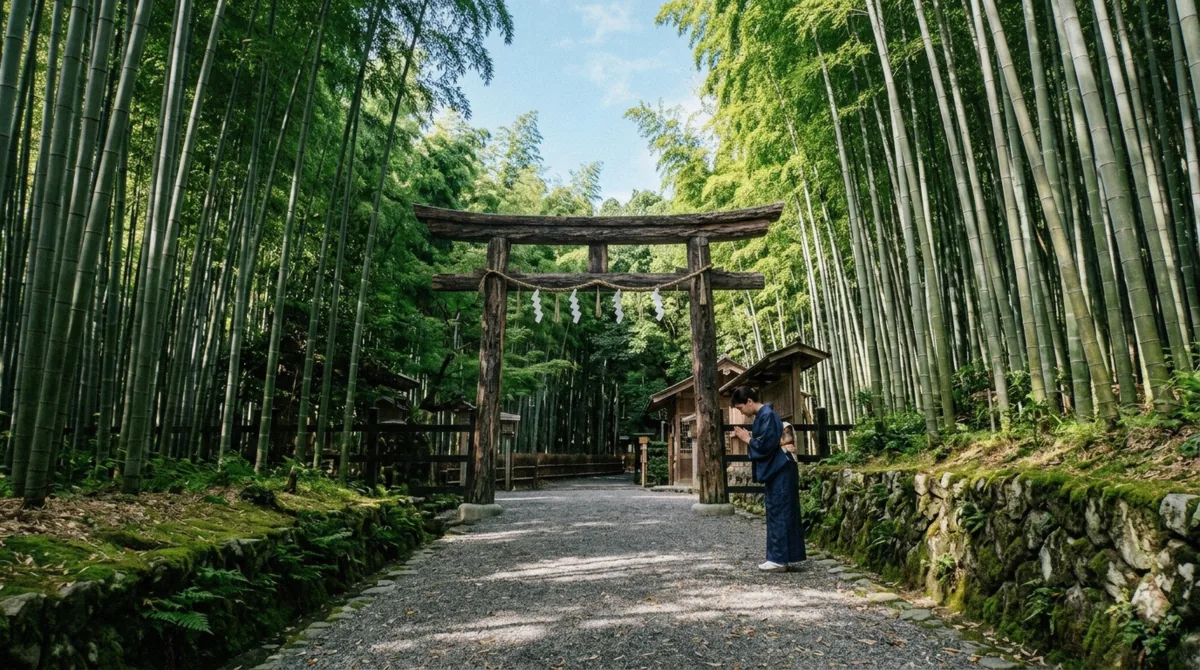
Just inside the grove's southern entrance sits Nonomiya Shrine, marked by a black-lacquered torii gate, itself unusual since most torii are vermilion. Free to enter, the shrine's history reaches back to the Heian era, when unmarried imperial princesses selected to serve as saio, ritual attendants at Ise Shrine, would retreat here for a period of purification before their formal departure. The institution outlived any single building: the shrine has been rebuilt repeatedly over the centuries, so what stands today is not Heian-era construction, but the role the site played in imperial ritual is.
The shrine also appears in literature. In the "Sakaki" chapter of the Tale of Genji, an early 11th century work often called the world's first novel, a scene is set at Nonomiya during exactly this kind of purification retreat, which is why the shrine still draws readers of the novel alongside visitors who simply notice the torii from the path.
Tenryu-ji: the temple that anchors the grove
At the grove's southern edge stands Tenryu-ji, a Zen temple founded in 1339 and recognized as a UNESCO World Heritage site in 1994 as part of the Historic Monuments of Ancient Kyoto. Its garden, open 8:30 to 17:00, costs ¥500 to enter, with an additional ¥300 to see the temple buildings. The temple's north gate opens directly into the bamboo grove, which is why a visit to Tenryu-ji and a walk through the grove are so often done as a single stop rather than two separate destinations; for the crowd-avoidance angle of entering this way, see our avoiding the crowds guide.
| Site | What it is | Fee |
|---|---|---|
| Chikurin-no-Komichi (the grove path) | The 400 m bamboo corridor itself | Free, open 24 hours |
| Nonomiya Shrine | Heian-era purification shrine, black torii | Free |
| Tenryu-ji garden | Zen temple founded 1339, UNESCO 1994 | ¥500 (+¥300 for the buildings), 8:30-17:00 |
| Okochi-Sanso villa | Actor Okochi Denjiro's hillside villa and garden | ¥1,000, includes matcha, 9:00-17:00 |
| Rakushisha | Basho's disciple's cottage, on the rickshaw long routes | Small entry fee; check current listing |
Okochi-Sanso: a 20th century addition
Past the grove's northern end sits Okochi-Sanso, a hillside villa and garden built over roughly 30 years by the film actor Okochi Denjiro, a star of Japanese silent and early sound cinema. Entry costs ¥1,000 and includes a bowl of matcha served with a view over the Arashiyama hills, open 9:00 to 17:00. Unlike the shrine and the temple, this is a comparatively recent layer of the district's history, added not by imperial or religious institutions but by one collector's decades of personal work on a single piece of land.
The Poet's Cottage and the Names
Rakushisha, the hut of fallen persimmons
West of the main grove, in the residential lanes of back-street Sagano, sits Rakushisha, the cottage of Mukai Kyorai, a disciple of the haiku master Matsuo Basho. Basho himself stayed there and wrote his Saga Diary in 1691, a short prose and verse record of his time in the district. It is not on the main tourist path through the bamboo and most visitors on foot never reach it; the longer options on the rickshaw tour route past it as part of their extended Sagano loop, which is one of the few ways to see it without deliberately seeking it out.
Free since around 2015
One detail that surprises repeat visitors comparing notes: the grove path itself charged a small entry fee at points before roughly 2015. Since then it has been free and open 24 hours a day, with no gate and no ticket booth on the main path. That change is part of why the grove now functions less like a managed attraction and more like a public route through the district, walked at all hours by locals and tourists alike, though a genuinely photogenic stretch of the closed lane inside remains rickshaw-only and off limits to pedestrians.
For more on what that access costs and whether it is worth booking, see our is it worth it page.
The Sagano Bamboo Forest, Era by Era
The district's recorded history in one sequence, from an imperial ritual to the free, 24-hour path that exists today.
-
Heian era
Saio princesses purify at Nonomiya
Unmarried imperial princesses selected to serve at Ise Shrine retreated to Nonomiya, inside what is now the grove, for ritual purification before departure.
-
Early 11th century
The Tale of Genji sets a scene here
The "Sakaki" chapter of the Tale of Genji places a scene at Nonomiya Shrine during a princess's purification retreat, fixing the site in literature.
-
1339
Tenryu-ji is founded
The Zen temple anchoring the grove's south end is established, later becoming one of Kyoto's most significant temples.
-
1691
Basho writes the Saga Diary at Rakushisha
The poet Matsuo Basho stays at his disciple Mukai Kyorai's cottage west of the grove and writes his short prose-and-verse Saga Diary.
-
20th century
Okochi-Sanso is built
Film actor Okochi Denjiro spends roughly 30 years building his hillside villa and garden at the grove's northern end.
-
1994
Tenryu-ji named UNESCO World Heritage
Tenryu-ji is inscribed as part of the Historic Monuments of Ancient Kyoto.
-
1996
The grove's sound joins the 100 Soundscapes of Japan
Japan's Ministry of Environment selects the wind through the bamboo as one of 100 recognized soundscapes nationwide.
-
Around 2015
The path becomes free
A small entry fee that had applied at points is dropped; the grove path has been free and open 24 hours since.
-
End of 2021
Hanatouro's original run ends
The lantern-lit night festival that once illuminated the path through the grove concludes its original format; see our best time to visit guide for what runs now.
Questions About the Sagano Bamboo Forest's History
Why is the grove called both Sagano and Arashiyama?
Sagano is the historically correct name for the flat district north of the Katsura River where the grove sits. Arashiyama, technically the mountain south of the river, became the name most commonly attached to the whole area over time, so both names lead to the same 400 metre path.
How long has bamboo been cultivated in this district?
Bamboo growing for building material and garden use has a long history in this part of Kyoto, tied to the temples and estates that have occupied the district for centuries. The grove as a defined, named path is a more recent framing of a much older local practice of tending Moso bamboo.
What is the oldest historical site inside the grove itself?
Nonomiya Shrine, whose role in imperial purification ritual dates to the Heian era, is the oldest layer of history directly inside the grove. The current shrine buildings have been rebuilt repeatedly, but the site's function is the historical thread that runs continuously back that far.
Did the bamboo forest always have a Zen temple next to it?
Tenryu-ji was founded in 1339, which means the temple has stood beside the grove for nearly seven centuries, though it predates the grove's current form as a defined walking path. Its founding is one of the reasons the area attracted the kind of upkeep that kept the bamboo grove intact through the centuries that followed.
Is any part of the historic grove now off limits?
Yes, one stretch. A fenced, photogenic section of the path is reserved for rickshaws operated by a single company and closed to pedestrians. It sits within the same historic corridor but is not part of the free public walk; our rickshaw tour page covers what that access includes.
None of this history requires a guidebook in hand to appreciate; a torii gate, a temple's north gate, a poet's cottage down a side lane all sit within a few minutes of the same path, and knowing what they are turns a short walk into something with real depth behind it. For the full range of ways to see it, browse the Sagano Bamboo Forest catalog.